
Lumora360 · Cultural traditions, thoughtfully explained
Face Reading: History, Symbolism & Science
Discover how different cultures imagined meaning in the human face, what their diagrams actually represent, and where modern evidence draws the line.
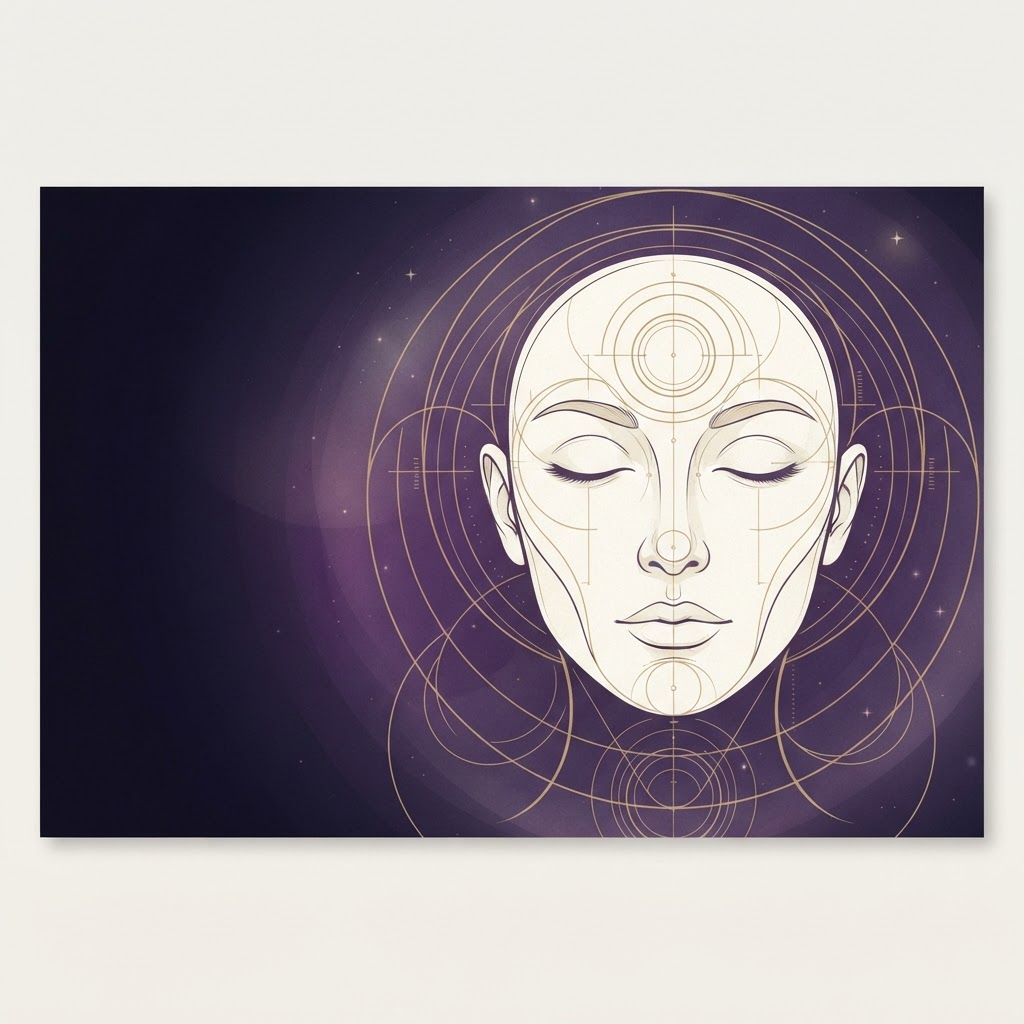
Education only. AI Face Reading is Coming Soon. Artwork is a modern AI-generated illustration, not a historical artifact.
Traditional belief
What a particular teaching says a feature symbolizes.
Historical evidence
What a manuscript, artifact or scholarly history documents.
Modern findings
What research can and cannot establish from facial images.
A cultural practice, not a personality test
What Is Face Reading?
Face reading assigns symbolic meaning to facial appearance. The broader historical term physiognomy refers to attempts to connect outward bodily form with character or destiny. Those attempted connections are beliefs to study, not reliable facts about a person.
A traditional reader might observe the forehead, eyes, nose and chin, then interpret them through a particular set of correspondences. Some frameworks organize features into life stages; others use cosmological categories or auspicious bodily signs. The observation and the interpretation are different steps: seeing a facial proportion is not evidence for the story attached to it.
There is no single worldwide face-reading system. Chinese Mian Xiang, Indian body-sign traditions and European physiognomy developed in different intellectual, religious and literary settings. Even within one tradition, texts, teachers and regional practices can disagree. Present-day online charts often combine systems without identifying their sources.
Historically, people used these practices to discuss fortune, social relationships, ideals of beauty and the relationship between the body and the wider world. That cultural influence makes them worth understanding. It does not make their predictive or personality claims scientifically valid. This guide studies symbolism without turning anyone’s appearance into a verdict.

J.C. Lavater, Essays on Physiognomy. Wellcome Collection. CC BY 4.0; resized by Wellcome’s image service. A historical illustration, not evidence for character-from-appearance claims.
Key learning points
- A physical description and a personality inference are not the same thing.
- Name the tradition before interpreting a symbol.
- Historical popularity is not scientific validation.
Is studying face reading the same as endorsing it?
No. We can examine a historical belief, how it circulated and what it meant to its users while rejecting unsupported judgments about actual people.
Sources & further reading (4)
- Encyclopaedia Britannica: Physiognomy (opens in a new tab)
Historical overview and the discrediting of character-from-appearance claims.
- Brill: The Physiognomic Conceptualisation of the Body Microcosm (opens in a new tab)
Scholarly reading on Chinese physiognomic conceptions of the body; publisher access may be required.
- Kenneth G. Zysk, The Indian System of Human Marks (Brill, 2016) (opens in a new tab)
Stanford Libraries catalogue and detailed contents of the scholarly editions, translations and literary history.
- Barrett et al. (2019), Emotional Expressions Reconsidered (opens in a new tab)
Research review explaining limits on inferring emotion from facial movements.
Several histories, not one unbroken invention
History & Origins
Face reading has appeared in multiple cultures. A careful history separates surviving documents from origin legends and avoids assigning a single founder or an exact ancient starting date without evidence.
In the Greek textual tradition, the Physiognomonica circulated under Aristotle’s name, but its authorship is disputed and it is often described as pseudo-Aristotelian. Comparisons between human and animal appearance supplied some of its reasoning. Resemblance was treated as a bridge to character, an assumption rather than a controlled scientific demonstration. Greek and Roman material later circulated through medieval European and Arabic scholarship.
Chinese physiognomy belonged to a wider world of divination and correspondences between the human body and the cosmos. Later manuals and oral teaching organized observations into regions, symbolic palaces and Five Phases associations. Historical accounts and modern schools should not be treated as interchangeable: the existence of an early reference does not date every diagram now sold as “ancient.”
Indian traditions interpreted marks across the whole body, not only the face. Kenneth G. Zysk’s study documents material in Jyotiḥśāstra, Purāṇic literature and independent Sāmudrikaśāstra treatises. His editions and translations show a layered textual history. Texts may be attributed to legendary authorities; such an attribution is not, by itself, proof of authorship or a date.
In Europe, Johann Kaspar Lavater’s Physiognomische Fragmente (1775–1778) helped popularize physiognomy through illustrated print culture. The Met’s pocket Lavater, dated 1829, shows its later circulation. In the nineteenth century, appearance-based classification also became entangled with racist, sexist and criminal stereotypes. Understanding that harm is essential: historical illustrations are documents of past ideas, not instructions for classifying people today.
J.C. Lavater, Essays on Physiognomy. Wellcome Collection. CC BY 4.0; resized by Wellcome’s image service. A historical illustration, not evidence for character-from-appearance claims.
Key learning points
- Treat disputed authorship as disputed.
- Distinguish a manuscript’s date from the age claimed for a tradition.
- Read historical classifications critically, including their discriminatory uses.
Did all face-reading traditions develop independently?
Contacts and textual exchange complicate the story. Zysk discusses connections across ancient cultures; this does not justify claiming that every modern system shares one origin.
Sources & further reading (5)
- Encyclopaedia Britannica: Physiognomy (opens in a new tab)
Historical overview and the discrediting of character-from-appearance claims.
- Britannica: Johann Kaspar Lavater (opens in a new tab)
Biography and publication dates of Essays on Physiognomy.
- The Metropolitan Museum of Art: The pocket Lavater (1829) (opens in a new tab)
Museum catalogue documenting the circulation of physiognomic books.
- Kenneth G. Zysk, The Indian System of Human Marks (Brill, 2016) (opens in a new tab)
Stanford Libraries catalogue and detailed contents of the scholarly editions, translations and literary history.
- Brill: The Physiognomic Conceptualisation of the Body Microcosm (opens in a new tab)
Scholarly reading on Chinese physiognomic conceptions of the body; publisher access may be required.
A fictional example, not an analysis service
How Face Reading Works
The sequence below explains how a traditional interpretation is assembled. Our diagrams use a fictional illustrated face. There is no camera, upload, facial measurement tool or assessment of a visitor.
Traditional methods vary, but readers commonly move from the whole face to smaller regions and then to an interpretive framework. Descriptive details can be observed; the subsequent symbolic meanings depend on the chosen school. Lighting, pose, expression, age and artistic style can change the apparent proportions even before interpretation begins.
This process does not scientifically establish personality or future outcomes. A neutral educational exercise asks how a text constructs meaning, not whether someone’s face makes them a good partner, employee or friend. Do not transfer the example to a photograph of a real person.
Step 1
Observe the overall face
Describe the fictional outline and pose without ranking beauty, normality or character. Separate a neutral description from any interpretation.
Step 2
Identify facial regions
Choose the boundaries used by the framework. In our illustrative Three Courts diagram, the hairline, brows, nose base and chin mark three broad regions.
Step 3
Examine individual features
Locate the brow, eyes, nose, mouth and chin. Do not turn a feature’s shape into a claim about intelligence or morality.
Step 4
Choose one symbolic framework
State whether the exercise concerns Mian Xiang, a named Indian text or another tradition. Do not silently mix their correspondences.
Step 5
Explain the symbolism
Use attributed language: “In this teaching, this region represents a life stage.” Different schools may supply different readings.
Step 6
Reflect on the interpretation
Ask what the metaphor meant to its cultural setting. A reflection question can be useful without treating the face as proof of an answer.
Key learning points
- Observation comes before an attributed interpretation.
- The framework supplies the meaning; the face does not verify it.
- Use fictional drawings rather than assessing other people.
Why not combine every tradition into one reading?
Combining incompatible maps can erase the context that gives each symbol its meaning. A transparent educational explanation names its framework and acknowledges disagreements.
Sources & further reading (4)
- Encyclopaedia Britannica: Physiognomy (opens in a new tab)
Historical overview and the discrediting of character-from-appearance claims.
- Mien Shiang: terminology and cited traditional texts (opens in a new tab)
Secondary terminology overview. The article flags citation limitations; school-specific descriptions are not scientific findings.
- Kenneth G. Zysk, The Indian System of Human Marks (Brill, 2016) (opens in a new tab)
Stanford Libraries catalogue and detailed contents of the scholarly editions, translations and literary history.
- Barrett et al. (2019), Emotional Expressions Reconsidered (opens in a new tab)
Research review explaining limits on inferring emotion from facial movements.
Three Courts, Twelve Palaces and Five Phases
Chinese Face Reading (Mian Xiang)
Mian Xiang (miànxiàng, 面相) is a Chinese physiognomic tradition. Its maps relate parts of the face to symbolic themes in human life. They are cultural interpretive systems, not validated diagnostic or predictive instruments.
In Chinese divinatory culture, the body could be imagined as a microcosm: a smaller world patterned through correspondences with the larger cosmos. Physiognomic writing drew on this way of thinking. Modern descriptions sometimes assign the entire practice a precise age or a single legendary inventor, but specific claims require specific textual evidence. This guide does not treat those origin stories as established dates.
The Three Courts, also called the Three Regions or San Ting, divide the face broadly into an upper region from the hairline to the brows, a middle region from the brows to the base of the nose, and a lower region from there to the chin. Some teachings relate them to early, middle and later life. Boundaries, translations and assigned age ranges vary, so our schematic does not print a supposedly universal schedule of years.
The Twelve Palaces organize more detailed life themes. Common English labels include life, wealth, siblings, partnership, children, health, travel, helpers, career, property, fortune and parents. A “palace” is a conceptual area, not an anatomical structure. The same facial area may appear in several overlapping systems. In particular, a traditional “health palace” is not a medical screening tool, and a partnership region cannot determine compatibility.
The Five Elements are more precisely called the Five Phases, or Wu Xing: Wood, Fire, Earth, Metal and Water. They describe relationships and processes of change in Chinese thought, not chemical ingredients in a face. Some contemporary schools connect these phases to facial outlines and seasonal metaphors. The assignment of a single feature or face shape is school-dependent and cannot establish someone’s temperament, ancestry or health.
Twelve Palaces: a symbolic map
One schematic arrangement of common labels. Positions, translations and overlaps vary by school. These are not anatomical organs or diagnostic zones.
- 1. Life
Between the brows in many charts
- 2. Wealth
Nose region
- 3. Siblings
Eyebrow region
- 4. Partnership
Outer eye / temple region
- 5. Children
Below the eyes
- 6. Health
Nose bridge region
- 7. Travel
Upper outer forehead
- 8. Helpers
Lower face / cheek region
- 9. Career
Central forehead
- 10. Property
Upper eyelid / brow space
- 11. Fortune
Upper forehead areas
- 12. Parents
Upper forehead, often paired areas
Original Lumora360 schematic. Historical labels such as “health” or “wealth” do not predict health or finances. No person is being assessed.
Five Phases, not five personality types
- Wood: Growth · spring
- Fire: Expansion · summer
- Earth: Transition · late summer
- Metal: Gathering · autumn
- Water: Storage · winter
Key learning points
- Three Courts are a broad symbolic division.
- Twelve Palaces are overlapping life-theme categories, not organs.
- Five Phases are metaphors; charts and translations differ between schools.
Are the Twelve Palaces the same as astrological houses?
No. The shared translation “palace” or “house” can be confusing. A face-reading palace is a symbolic facial area; it is not a calculated horoscope house.
Sources & further reading (4)
- Brill: The Physiognomic Conceptualisation of the Body Microcosm (opens in a new tab)
Scholarly reading on Chinese physiognomic conceptions of the body; publisher access may be required.
- Mien Shiang: terminology and cited traditional texts (opens in a new tab)
Secondary terminology overview. The article flags citation limitations; school-specific descriptions are not scientific findings.
- Mien Shiang Institute: a contemporary practitioner perspective (opens in a new tab)
Documents a modern Five Elements interpretation. Its diagnostic and personality claims are traditional beliefs, not endorsed scientific evidence.
- Barrett et al. (2019), Emotional Expressions Reconsidered (opens in a new tab)
Research review explaining limits on inferring emotion from facial movements.
The face within a wider body-sign tradition
Indian Face Reading (Samudrika Shastra)
Samudrika Shastra, or Sāmudrikaśāstra, refers to Indian traditions concerning bodily marks and their interpretation. Face reading is only part of a larger field that also includes the hands, feet, proportions and other bodily signs.
The Sanskrit vocabulary of lakṣaṇa concerns signs, marks or distinguishing characteristics. In divinatory texts, visible bodily signs were read as auspicious or inauspicious and associated with a person’s fortunes. These historical categories should not be confused with anatomical diagnoses or accepted measures of personal worth. Nor does the word śāstra, a structured treatise or field of knowledge, mean that its claims have been scientifically validated.
Zysk’s The Indian System of Human Marks traces this material through Jyotiḥśāstra, Purāṇas and independent treatises, with Sanskrit texts, translations and annotations. That record is more complex than a modern list of “face secrets.” Manuscripts can preserve different selections, commentaries and regional readings. Religious attribution and a manuscript’s physical age are separate historical questions.
Auspicious body-sign language also matters in South Asian religious and artistic settings, where an idealized figure can communicate exceptional status through conventional marks. Such imagery belongs to its specific narrative and devotional context. It is not a standard for evaluating the faces, disability, gender or social status of living people. Older gendered and hierarchical assumptions require critical explanation rather than repetition as rules.
Chinese Mian Xiang often introduces the Three Courts, Twelve Palaces and Wu Xing. Indian body-sign literature uses its own textual lists, categories and philosophical settings. Translating both as “face reading” does not make their maps equivalent. For instance, studying a Sāmudrika palm manuscript documents the broader body-sign tradition; it does not provide evidence for a Chinese-style palace diagram.

Sāmudrika, Ms. Coll. 390 Item 778, fol. 1r. Penn Libraries, Kislak Center / OPenn. Public Domain Mark 1.0. A palm-reader’s guide within the broader body-sign tradition, not a face-reading chart.
Key learning points
- The face is one part of a broader body-sign tradition.
- A manuscript documents a cultural practice, not predictive accuracy.
- Do not equate Indian categories with Chinese palace or phase maps.
Is Samudrika Shastra simply another name for palmistry?
No. Palmistry is a related practice within a broader body-sign field. A particular manuscript may focus on palms, while other texts discuss different parts of the body.
Sources & further reading (3)
- Kenneth G. Zysk, The Indian System of Human Marks (Brill, 2016) (opens in a new tab)
Stanford Libraries catalogue and detailed contents of the scholarly editions, translations and literary history.
- Penn Libraries: Sāmudrika, Ms. Coll. 390 Item 778 (opens in a new tab)
An actual manuscript in the broader body-sign/palmistry tradition, not a facial-analysis chart.
- Encyclopaedia Britannica: Physiognomy (opens in a new tab)
Historical overview and the discrediting of character-from-appearance claims.
An anatomical description is not a character judgment
Facial Features & Symbolism
These visual cards distinguish a physical region from the symbolism attached to it. The traditional examples below primarily describe common Chinese Mian Xiang terminology; they are not universal teachings or a blended Indian–Chinese system. European and Indian traditions need their own textual context.
Do not use these illustrations to score a photograph, rank appearance or judge someone else. A tradition’s vocabulary is a subject for cultural study, not a reliable assessment of the person whose face you see.
Forehead
- Anatomy
- The upper facial area above the brows, overlying the frontal bone.
- Attributed traditional symbolism
- In common Mian Xiang Three Courts descriptions, this belongs to the upper region, symbolically associated with early life. Some palace charts also place career-related symbolism on the forehead.
- Example
- A chart’s “early life” label identifies a theme, not a record of childhood or a measure of intelligence.
Scientific limit: this feature does not reliably establish personality, intelligence, honesty, morality, psychological condition or future outcomes.
Eyes
- Anatomy
- The eyes and surrounding eyelids; gaze direction and lid movement can change moment to moment.
- Attributed traditional symbolism
- Eyes are among the Five Officers in Chinese physiognomic terminology. Some traditions discuss their appearance using the language of spirit or vitality; these are interpretive concepts, not measurements of a person’s inner life.
- Example
- Compare a drawing with open and partly closed lids. A change in pose is not evidence of a different character.
Scientific limit: this feature does not reliably establish personality, intelligence, honesty, morality, psychological condition or future outcomes.
Eyebrows
- Anatomy
- Hair-bearing ridges above the eyes; shape also reflects grooming and expression.
- Attributed traditional symbolism
- The eyebrow region is commonly connected with the Siblings Palace in Mian Xiang. This is a symbolic association with relationships, not information about how many siblings someone has.
- Example
- Ask why a historical chart connected paired brows with companionship, rather than predicting a person’s family life.
Scientific limit: this feature does not reliably establish personality, intelligence, honesty, morality, psychological condition or future outcomes.
Nose
- Anatomy
- The projecting central structure, including the bridge, tip and nostril region.
- Attributed traditional symbolism
- Many Mian Xiang maps associate the nose region with the Wealth Palace. The bridge may also appear in a separate health-related palace map, showing how symbolic systems can overlap.
- Example
- “Wealth Palace” is the traditional name of a symbolic region, not a reliable indicator of income, luck or medical health.
Scientific limit: this feature does not reliably establish personality, intelligence, honesty, morality, psychological condition or future outcomes.
Ears
- Anatomy
- The external ears sit to either side of the head and include the pinna and lobule.
- Attributed traditional symbolism
- Ears are included among the Five Officers in Chinese face-reading terminology. Their inclusion shows the framework extends beyond the central face; teachings differ in their specific associations.
- Example
- Listing an ear as an “officer” describes a cultural category. It does not test wisdom, intelligence or longevity.
Scientific limit: this feature does not reliably establish personality, intelligence, honesty, morality, psychological condition or future outcomes.
Lips and mouth
- Anatomy
- The lips surround the mouth opening; speech, eating and expression involve changing movements.
- Attributed traditional symbolism
- The mouth is another of the Five Officers in Chinese physiognomy. It can carry traditional symbolism around speech or provision, but lip form cannot tell us whether someone speaks honestly.
- Example
- Separate the observable act of lip movement from the unsupported idea that a mouth shape indicates trustworthiness.
Scientific limit: this feature does not reliably establish personality, intelligence, honesty, morality, psychological condition or future outcomes.
Chin
- Anatomy
- The frontmost lower part of the mandible, beneath the mouth.
- Attributed traditional symbolism
- In common Three Courts schemes, the chin sits in the lower region and is connected symbolically with later life. It is not a measure of strength, determination or future security.
- Example
- Use “later life” as a prompt to discuss cultural hopes for support, not to predict an individual’s old age.
Scientific limit: this feature does not reliably establish personality, intelligence, honesty, morality, psychological condition or future outcomes.
Jawline
- Anatomy
- The lower facial contour follows the mandible and the surrounding soft tissues.
- Attributed traditional symbolism
- The jawline contributes to overall form in physiognomic descriptions, including the lower-face outline in Chinese schemes. Specific character claims attached to it vary by text and are not reliable assessments.
- Example
- A strongly drawn jaw in an illustration is an artistic choice. It does not demonstrate leadership, aggression or morality.
Scientific limit: this feature does not reliably establish personality, intelligence, honesty, morality, psychological condition or future outcomes.
Facial proportions
- Anatomy
- Relative distances between landmarks; they vary with pose, lens, age and individual anatomy.
- Attributed traditional symbolism
- Three Courts teaching compares broad vertical regions. European physiognomic books also compared outlines and profiles, but their meanings should not be merged with Chinese ones.
- Example
- A diagram can explain a ratio without making it an ideal beauty standard or a score of intelligence, worth or destiny.
Scientific limit: this feature does not reliably establish personality, intelligence, honesty, morality, psychological condition or future outcomes.
Sources & further reading (5)
- Mien Shiang: terminology and cited traditional texts (opens in a new tab)
Secondary terminology overview. The article flags citation limitations; school-specific descriptions are not scientific findings.
- Brill: The Physiognomic Conceptualisation of the Body Microcosm (opens in a new tab)
Scholarly reading on Chinese physiognomic conceptions of the body; publisher access may be required.
- Encyclopaedia Britannica: Physiognomy (opens in a new tab)
Historical overview and the discrediting of character-from-appearance claims.
- Wellcome Collection: J.C. Lavater, Essays on Physiognomy (opens in a new tab)
Digitized historical illustration, CC BY 4.0. Historical evidence of a belief, not evidence that it works.
- Barrett et al. (2019), Emotional Expressions Reconsidered (opens in a new tab)
Research review explaining limits on inferring emotion from facial movements.
Different questions need different evidence
Face Reading vs. Modern Science
A computer can locate facial landmarks, and a trained observer can describe facial movement. Neither ability establishes a valid route from facial appearance to personality, honesty, morality or the future.
Traditional physiognomy attaches character or fortune to appearance. Facial anatomy instead studies structures such as bones, muscles and skin. Facial-expression research studies movement and communication in context. These fields ask different questions. Measuring something accurately does not automatically validate every interpretation attached to the measurement.
The Facial Action Coding System (FACS), developed by Paul Ekman and Wallace Friesen, describes observable facial actions using anatomically based action units. For example, AU1 describes an inner-brow raising action and AU12 a lip-corner pulling action. An action unit describes a movement, not a personality trait. The same visible action may occur in different situations and is not a direct test of a private emotional state.
Research on expression and emotion remains more nuanced than a fixed “one face equals one feeling” chart. Barrett and colleagues’ 2019 review discusses variation across individuals, cultures and situations. A smile may serve several social functions. A still photograph loses timing, surrounding events and the person’s own account. Physiognomic claims about stable character go further still, without a validated basis for judging an individual.
Computer vision is a broad family of methods for processing images. Face detection locates a face; landmark estimation locates points; facial recognition compares an image with an enrolled identity or a database. None of these tasks is a personality test. Successful recognition does not imply a system can determine intelligence, honesty, psychological condition or sensitive personal characteristics.
Privacy matters even when an image is public. Faces can be identifying, biometric templates can be sensitive, and reuse may occur without meaningful consent. The 2018 Gender Shades study found unequal performance in specific commercial gender-classification systems; it did not test personality inference or identity matching. NIST separately evaluated demographic effects in face-recognition errors. The tasks, samples and dates matter: neither study should be simplified into a claim about every current AI system.
Symbolic regions
A tradition supplies the meanings. The regions do not establish a character or future.
Observable movements
Action units describe visible changes. They do not prove an emotion, intention or lie.
| Field | What it describes | What not to infer |
|---|---|---|
| Traditional physiognomy | Symbolic links between appearance and life themes | Not a validated personality, character or future assessment |
| Facial anatomy | Physical structures, tissues and muscles | Structure is not a moral or intellectual ranking |
| FACS / facial movement | Observable actions and changes over time | A coded action alone does not reveal an emotion or a lie |
| Computer vision / landmarks | Locating faces and positions in images | Coordinates do not establish personality or sensitive traits |
| Facial recognition | Comparing an image with identity records | Can make errors; raises consent, surveillance and bias concerns |
Key learning points
- FACS codes movement, not moral character.
- Recognition compares identity; physiognomy proposes symbolic meanings.
- Accuracy, consent, context and bias need separate scrutiny.
Does using AI make a traditional claim scientific?
No. Automation can reproduce an unsupported assumption at scale. A valid claim needs appropriate evidence, independent evaluation and careful limits, not simply an algorithm or an impressive-looking diagram.
Sources & further reading (5)
- Paul Ekman Group: Facial Action Coding System (opens in a new tab)
Anatomically based description of observable facial movements.
- Barrett et al. (2019), Emotional Expressions Reconsidered (opens in a new tab)
Research review explaining limits on inferring emotion from facial movements.
- MIT News: Gender Shades research (2018) (opens in a new tab)
Study of commercial gender-classification systems, not a test of face-reading or personality prediction.
- NIST IR 8280 (2019): Face Recognition Vendor Test, Demographic Effects (opens in a new tab)
Separate evaluation of identity-matching errors and demographic differences. Historical findings, not a rating of every current system.
- Encyclopaedia Britannica: Physiognomy (opens in a new tab)
Historical overview and the discrediting of character-from-appearance claims.
Common questions, honest boundaries
Face Reading FAQs
Start with the distinction in this illustration: a face can be described without claiming to know the person’s mind. Open a question for an explanation and a link to the relevant visual guide.
What is face reading?
A collection of cultural practices that assign symbolic meanings to facial form and features. The broader historical term physiognomy also covers bodily appearance. Different traditions use different maps; this guide explains them rather than assessing visitors.
Explore the related illustrated section →Is face reading scientifically proven?
No. Traditional face-reading maps are not scientifically validated personality or fortune assessments. A historical manuscript proves that a teaching existed, not that it accurately describes real people. See the comparison diagram for the difference between observable structure and unsupported inference.
Explore the related illustrated section →Can facial features reveal personality?
They do not provide a reliable basis for determining an individual’s personality. Observers can form quick impressions from appearance, but agreement between observers does not show that an impression is accurate. Pose, expression, lighting and stereotypes also influence those impressions.
Explore the related illustrated section →Can face reading predict the future?
There is no scientifically validated basis for predicting a person’s future from facial features. Traditional life-stage maps can be studied as cultural metaphors, not as evidence that a particular event will happen.
Explore the related illustrated section →What is Mian Xiang?
Mian Xiang is a Chinese physiognomic tradition, also romanized Mien Shiang. Teaching can include the Three Courts, Twelve Palaces and Five Phases. Schools and translations differ. None of these maps is an accepted personality or medical diagnostic test.
Explore the related illustrated section →What is Samudrika Shastra?
An Indian body-sign tradition whose texts concern the interpretation of bodily marks, proportions and features. The face is only one part; hands and other body regions also appear. Zysk’s textual history and the Penn manuscript provide different kinds of historical evidence.
Explore the related illustrated section →What are the Three Courts?
A broad division into upper, middle and lower facial regions, commonly bounded by the hairline, brows, nose base and chin. Some teachings associate these regions with early, middle and later life. The illustration shows a general convention, not a universal chart or a schedule of predictions.
Explore the related illustrated section →What are the Twelve Palaces?
Symbolic areas associated with themes such as life, wealth, siblings, partnership, children, health, travel, helpers, career, property, fortune and parents. These are not anatomical structures or horoscope houses. Translations, locations and meanings vary, and the “health” label must not be used for diagnosis.
Explore the related illustrated section →Can AI analyze facial images?
Computer vision can detect faces, estimate landmarks or compare images for identity-related tasks. Those technical abilities do not validate personality, honesty or future predictions. Faces also raise important consent, identification and bias concerns. No facial image analysis is enabled on this page.
Explore the related illustrated section →How is face reading different from facial recognition?
Face reading attaches symbolic meanings to appearance. Facial recognition compares an image with an identity record or a database. Recognition can still make errors and create privacy risks, but it is a different task from physiognomic interpretation.
Explore the related illustrated section →Can face reading determine intelligence or honesty?
No. Neither traditional face-reading charts nor an AI-generated score provides a reliable basis for those judgments. Do not use appearance to make hiring, relationship, credit, education or other consequential decisions. FACS describes visible movements; it is not a lie detector.
Explore the related illustrated section →Will Lumora360 offer AI Face Reading?
AI Face Reading is Coming Soon as a possible future cultural and symbolic learning experience. No release date or analysis capability is promised. This release does not enable camera access, uploads, facial recognition, AI personality analysis, reports or payments for Face Reading.
Explore the related illustrated section →Sources & further reading (6)
- Encyclopaedia Britannica: Physiognomy (opens in a new tab)
Historical overview and the discrediting of character-from-appearance claims.
- Kenneth G. Zysk, The Indian System of Human Marks (Brill, 2016) (opens in a new tab)
Stanford Libraries catalogue and detailed contents of the scholarly editions, translations and literary history.
- Paul Ekman Group: Facial Action Coding System (opens in a new tab)
Anatomically based description of observable facial movements.
- Barrett et al. (2019), Emotional Expressions Reconsidered (opens in a new tab)
Research review explaining limits on inferring emotion from facial movements.
- MIT News: Gender Shades research (2018) (opens in a new tab)
Study of commercial gender-classification systems, not a test of face-reading or personality prediction.
- NIST IR 8280 (2019): Face Recognition Vendor Test, Demographic Effects (opens in a new tab)
Separate evaluation of identity-matching errors and demographic differences. Historical findings, not a rating of every current system.
A future cultural learning experience
AI Face Reading — Coming Soon
AI Face Reading
Explore the cultural traditions and symbolic interpretations of face reading through a future interactive Lumora360 experience.
No launch date or capabilities are promised. This tile is informational only.
Education is available now. Face Reading does not currently offer camera access, photo uploads, facial recognition, AI personality analysis, report generation or payments. Nothing on this page collects a facial image or initiates analysis.
Face reading is a historical and cultural interpretive practice, not a scientifically validated personality assessment. Facial appearance does not reliably reveal intelligence, trustworthiness, morality, psychological condition or future outcomes. Do not use it to make decisions about real people.
Artwork: AI-generated editorial illustration created for Lumora360. This is a fictional face, not a historical manuscript or an assessment result. No explainer video for this future experience has been produced.
Sources & further reading (3)
- Barrett et al. (2019), Emotional Expressions Reconsidered (opens in a new tab)
Research review explaining limits on inferring emotion from facial movements.
- MIT News: Gender Shades research (2018) (opens in a new tab)
Study of commercial gender-classification systems, not a test of face-reading or personality prediction.
- NIST IR 8280 (2019): Face Recognition Vendor Test, Demographic Effects (opens in a new tab)
Separate evaluation of identity-matching errors and demographic differences. Historical findings, not a rating of every current system.